Understanding
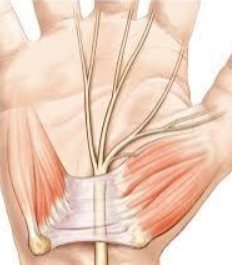
The median nerve
One of the main nerves of the hand, it provides feeling in the thumb, index, middle finger and half of the ring finger. It also controls the muscles that help the thumb move and grip objects (opponens and abductor muscles).
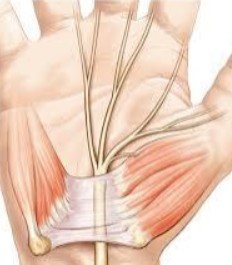
The carpal tunnel
A narrow space on the palm side of the wrist, with the wrist bones underneath and a thick ligament, the flexor retinaculum, on top. The median nerve and nine flexor tendons pass through it.
The syndrome
If the tunnel becomes narrower — often due to swelling of the tendon linings (tenosynovitis) — the median nerve is compressed, causing pain, numbness or tingling in the fingers. Diagnosis is usually confirmed with an EMG, sometimes with an ultrasound.
Treatment options
Without surgery
- Night splint
- Steroid (cortisone) injection to reduce inflammation
With surgery
When splints and injections no longer help, or straight away in severe cases (muscle weakness, early nerve damage), to prevent permanent nerve damage.
Why not wait? Without treatment, the median nerve may suffer permanent damage: numb fingers, thumb muscle shrinkage and weakened grip strength.
How the procedure works
- 1
Anaesthesia
Local or regional anaesthesia: only the hand is numbed.
- 2
Incision
A small cut is made on the palm near the base of the thumb.
- 3
Release
The thick ligament pressing on the nerve is cut, releasing the pressure.
- 4
Synovectomy if needed
If the tendon lining is inflamed (tenosynovitis), it may also be removed.
Other surgical options include endoscopic surgery (with a camera) and ultrasound-guided surgery.
After surgery
- Right after
Your hand is placed in a sling to reduce swelling.
- Same day
You can move your fingers, keeping the wound clean and dry.
- Until the stitches are out
A light dressing is kept until the stitches are removed.
Risks and complications
Every procedure carries risks, even when performed under the best conditions. They will be discussed with you during your consultation.
During surgery
- Nerve injury (very rare)
After surgery
- Bruising (hematoma)
- Infection (rare)
Long term
- Scar tenderness
- Temporary loss of hand strength
- Complex regional pain syndrome (CRPS), a rare painful hand condition
To relieve pressure on the median nerve, prevent permanent nerve damage, and restore the function and feeling in your hand.
Sources
- Miller LE et al. Best-evidence systematic review and meta-analysis of endoscopic carpal tunnel release outcomes. J Hand Surg Glob Online, 2023.
- Malakootian M et al. Pathophysiology, diagnosis, treatments, and genetics of carpal tunnel syndrome: a review. Cell Mol Neurobiol, 2023;43(5):1817-1831.
This sheet provides general information. It does not replace a consultation, during which your situation is assessed individually.